AI Video Is Learning to Direct. By 2030, the Valuable Part Won't Be the Clip.
AI video moved from five-second tricks to referenced, editable, audio-synchronised production. Cheap generation will make worlds, rights, edit decisions and taste more valuable.
In 2022, the flex was getting a model to make five coherent seconds from a sentence.
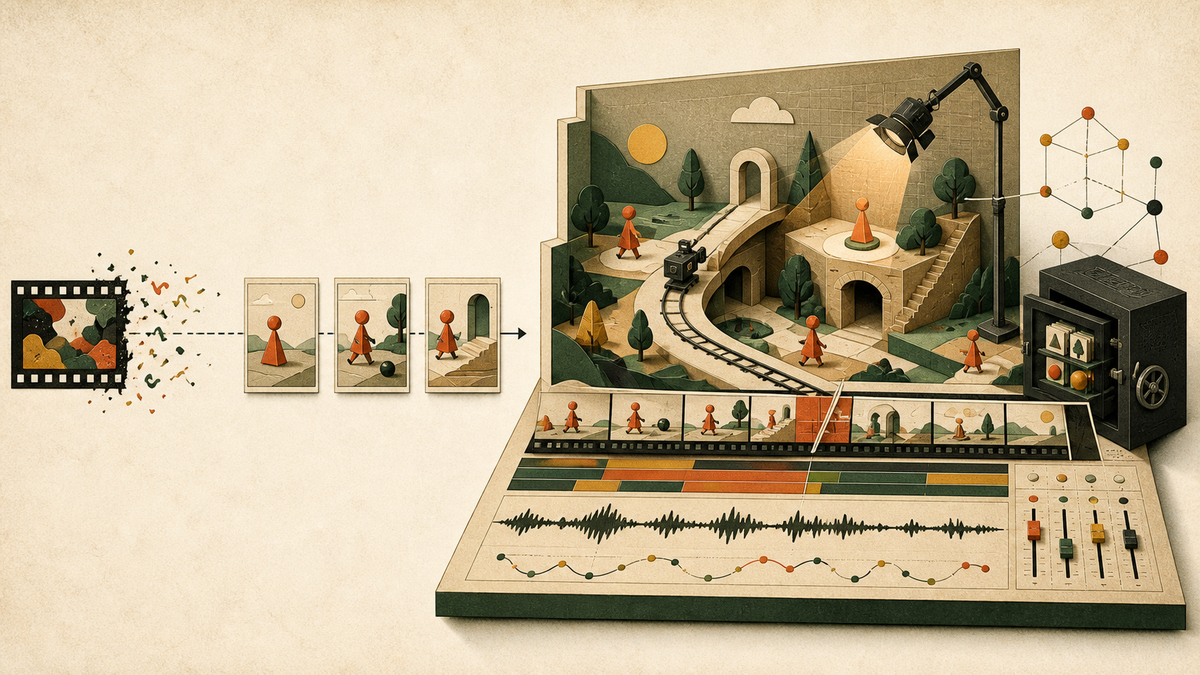
In 2026, I can give a model a storyboard, character images, reference video, audio and an editing instruction. It can return a multi-shot sequence with dialogue, ambience and camera movement.
Four years.
Calling this "video quality improved" feels a bit like saying the phone got better between a landline and an iPhone.
The product changed.
Video AI is moving from generating a clip to operating a tiny production system. It can increasingly take direction, preserve identity, revise a shot and coordinate sound with motion.
The demos are already good enough to create a second misunderstanding: that long-form films are basically solved and we are waiting for more GPU.
I do not think that is what happens.
By 2030, basic generation will be cheap. The valuable layer will be everything that lets a person control 10,000 generated possibilities and turn a few of them into something coherent, ownable and worth watching.
2022: five seconds was research
Meta's Make-A-Video and Google's Imagen Video were early signals that text-to-image diffusion could extend into time.
Imagen Video generated 5.3-second clips at 1280x768 and 24 frames per second through a cascade of models. Google also showed Phenaki, which explored variable-length generation.
The clips were obviously research outputs. Short, unstable, often strange.
But the core move was there: represent an instruction, visual appearance and motion inside one generative process.
We had crossed from "animate this template" to "synthesise a scene that never existed."
2023: generation becomes a product
Runway's Gen-2 turned the research direction into something creators could use. Text, image and video could guide a new video.
This mattered as much as a benchmark result.
Most technology curves accelerate when the awkward research interface becomes a product loop. People try thousands of weird prompts, discover repeatable workflows and reveal the actual failures.
The failure was not mainly resolution.
It was control.
You could get one beautiful shot and fail to reproduce the character, room, product or camera decision in the next one. The model did not have a durable world. It had a prompt and a fresh roll of the dice.
2024: a clip starts pretending to be a world
OpenAI's first Sora technical report showed videos up to a minute long at high resolution and introduced the idea of spacetime patches.
The "world simulator" language got repeated everywhere. Some of it was marketing. Some of it was an important research claim.
To generate plausible video, a model has to learn partial regularities about objects, motion, cameras and persistence. The report showed simple forms of object permanence emerging with scale. It also documented obvious failures in physics and causality.
Length alone did not solve narrative.
A minute of locally plausible motion can still be globally nonsense.
The model can remember that a dog exists for a shot. A production needs to remember who the dog belongs to, which paw was injured three scenes ago and why the audience should care.
That state does not live in pixels alone.
2025: control, consistency and sound arrive
Runway's Gen-4 pushed consistent characters, locations and objects across scenes. Google's Veo 3.1 added native audio, reference ingredients, scene extension, first-and-last-frame control and object insertion.
Sora 2 added synchronised dialogue and sound effects alongside better physical behaviour and control. Its product availability later changed in April 2026, a useful reminder that a strong model and a durable product are not the same thing.
Runway's Gen-4.5 improved motion quality, instruction following and temporal consistency again.
Notice what the release notes stopped leading with.
Not pixels.
Control. Consistency. Editing. Audio. References.
The model race was starting to look like the product stack used by a director and editor.
2026: the input becomes a production brief
ByteDance's Seedance 2.0 is a clean example of where the curve has reached.
It accepts text, images, video and audio together. A user can supply up to nine images, three video clips and three audio clips as references. It can create a 15-second multi-shot audio-video output, extend an existing video and edit specified characters, actions or story elements.
ByteDance still notes weaknesses in fine detail, complex edits, multi-subject consistency and occasional audio distortion.
But compare the input with 2022.
2022: describe a scene.
2026: provide the cast, visual language, storyboard, movement, sound and revision.
The prompt is turning into a brief.
The six curves inside "better video"
Video AI progress gets compressed into one leaderboard score. I think it is six different curves.
1. Visual quality
Resolution, texture, lighting, faces. This improved first and is the easiest to notice.
2. Motion and physics
Can bodies, fluids, fabric and cameras move without quietly violating reality?
Still uneven, but much better than the morphing objects of 2022.
3. Identity and world consistency
Can the same person, product and location survive multiple shots?
This is the bridge from a clip generator to production.
4. Instruction following
Can the model obey camera, blocking, timing and action requirements instead of returning a beautiful adjacent idea?
Professionals care about this more than another 5% of benchmark preference.
5. Editing
Can a user change one part without regenerating and re-rolling everything?
Revision is the real creative workflow. Generation gets the demo. Editing gets the invoice paid.
6. Audio-video coordination
Dialogue, foley, ambience, music and lip movement need to share time.
Native audio removes an entire stitching workflow and adds another huge control problem.
Progress across these curves is fast.
The remaining problems are stubborn because they are less about producing pixels and more about preserving intent.
A good shot is not a good story
Long-form video requires different memory.
A film has character state, world rules, emotional arcs, visual motifs, pacing, continuity, rights and thousands of edit decisions. Some of those can be encoded. Some are discovered through the act of making the work.
The model can give you 100 competent shots.
Now somebody has to decide:
- which one belongs in this story
- which performance feels true
- what information the audience should not know yet
- whether the shot should last two seconds or eight
- what the previous shot made us feel
- whether the whole thing resembles someone else's work too closely
Generation reduces the cost of options.
It increases the cost of choosing.
This is why I expect taste and edit decisions to become more valuable, not less, even as the manual mechanics of production compress.
The market is already splitting by job
"AI video" hides several products with different economics.
Foundation and world models
Google, OpenAI, ByteDance, Runway, Kuaishou/Kling, Luma, Pika and open model teams compete on general video generation, control and simulation.
This is the capex-heavy layer. A small number of labs can fund frontier training.
Avatar and enterprise video
Synthesia, HeyGen, Tavus and others focus on presenters, translation, training, sales and communication.
The output is narrower. That is a strength. The buyer knows the job and can compare it with a production budget.
Workflow and editing
Creative suites and new tools connect scripting, storyboards, generation, asset management, revision and post-production.
This layer may be model-agnostic because a real production will use different models for different shots.
Rights, data and identity
Licensed libraries, consent systems, provenance, character rights and brand controls become infrastructure when generated media reaches volume.
Compute and delivery
Training data systems, storage, video inference, rendering and distribution remain expensive under the magic.
The market will not collapse into one "best video model" because the jobs do not collapse.
Follow the money: narrow jobs are already real businesses
Runway raised more than $300 million in 2025 to build world models and expand its studio. A further 2026 round was reported at $315 million and a $5.3 billion valuation.
It also launched a $10 million fund focused on AI research, applications and new media. That is a foundation-model company explicitly betting that value will spread through an ecosystem.
At the application layer, Synthesia raised $200 million at a $4 billion valuation in January 2026 around enterprise training and knowledge video.
HeyGen said it passed $200 million in ARR in June 2026, doubling in eight months. That is company-reported, but it points to the same pattern.
The repeatable revenue is not waiting for a fully autonomous film studio.
It is already showing up in narrower jobs: localisation, presenters, training, sales content, performance marketing and pre-visualisation.
Runway and Lionsgate expanded their partnership in June 2026 to include co-developed projects using existing IP. The practical bridge into Hollywood is not "type a movie". It is attaching generation to IP, production judgement and distribution that already exist.
Capital is funding both frontier models and the workflows that make them usable. I expect the middle layer of generic clip generators to feel the most pressure.
Six predictions for 2030
1. Basic shot generation becomes a commodity
Confidence: high
Short, attractive B-roll will be available inside every editor, ad product and creative suite. Most users will not know which model produced it.
This is wrong if a small set of APIs can still charge a large premium for basic short clips in 2030.
2. The canonical world becomes the production asset
Confidence: high
Productions will maintain a durable representation of characters, environments, props, visual rules, voices, relationships and timeline state.
Prompts will query and update that world rather than re-describe it every time.
This is wrong if long productions remain mostly prompt-by-prompt with no persistent identity or scene layer.
3. Most commercial video becomes AI-assisted, not unsupervised
Confidence: high
AI will touch scripting, storyboards, pre-vis, asset creation, translation, versions, effects and editing. A human will still own the brief, selection and approval for consequential brand work.
The job changes from manually producing every frame to directing and verifying a production system.
This is wrong if major brands routinely ship end-to-end campaigns with no meaningful human creative review.
4. Avatar video wins enterprise volume before cinematic generation
Confidence: medium-high
Training, onboarding, support, sales and localisation have repeatable formats and measurable production savings. They do not require the model to invent a good story.
This is wrong if cinematic prompt-to-video creates more repeat enterprise revenue than training, localisation and presenter workflows.
5. Rights become part of the product architecture
Confidence: high
Professional tools will store who consented to what, where an asset came from, which styles or identities are restricted, and how an output can be used.
Rights metadata will travel with characters and generated assets, not live in an email attachment someone loses.
This is wrong if provenance, licensing and identity controls remain optional in serious production workflows.
6. Simulation becomes a larger value pool than AI entertainment
Confidence: medium
The same models that learn motion, causality and environments can generate training worlds for robots, autonomous systems, games and spatial agents.
Entertainment gets the attention because the output is visible. Simulation may get more economic value because it can produce endless interactive experience unavailable in the physical world.
This is wrong if video models remain mainly passive content generators by 2030.
What I would build around
I would be cautious about building one more interface to the current best video model.
The model ranking will change before the landing page ships.
I would look for one of these:
- a production job with a repeated format and clear budget
- a persistent world/character system that survives model changes
- an editing or evaluation loop that reduces re-rolls
- licensed data or rights infrastructure
- distribution tied to performance data
- a vertical workflow where video is an input to an outcome
- simulation for training, planning or games
The moat is unlikely to be "our generations look 8% better this month."
It might be that the system knows the brand, the characters, the legal permissions, the past edits and what performed in market.
Cheap video does not create cheap attention
By 2030, we will be able to generate more video than any human could watch.
That sentence should make every founder in the space slightly nervous.
When production becomes abundant, attention does not expand to meet it. If anything, the filter gets harsher.
The valuable work moves from making pixels to deciding what deserves to exist, preserving a coherent world, controlling the result and reaching an audience that cares.
AI video is learning to direct.
That does not remove directors. It changes what they direct.
The clip is getting cheap.
The world around it is about to become the product.
Research note: technical milestones link to original papers or first-party model releases. Company funding and revenue figures are identified as company-reported or linked to the reporting source. Predictions are my own and include conditions under which I would consider them wrong.